Color Trading Prediction: Why It Fails
Testing the promise of an edge
"Follow our signals, use the level maintain table, and you will never lose more than one round." Versions of that line circulate in Telegram groups, YouTube comments and forwarded screenshots, and they all sell the same idea: color trading prediction is a skill you can learn or buy. This page takes the claim apart piece by piece. It looks at who decides a result, what a history chart can tell you, how stake-doubling tables behave over a bad run, and why the people selling signals are rarely the ones taking the risk.
First, a word on scope. Colour-betting rounds are run by many unnamed operators, and each app sets its own rules, timers and payout labels. Where we describe a typical layout below, it is how such apps usually present the game, not a standard.
Who decides the colour
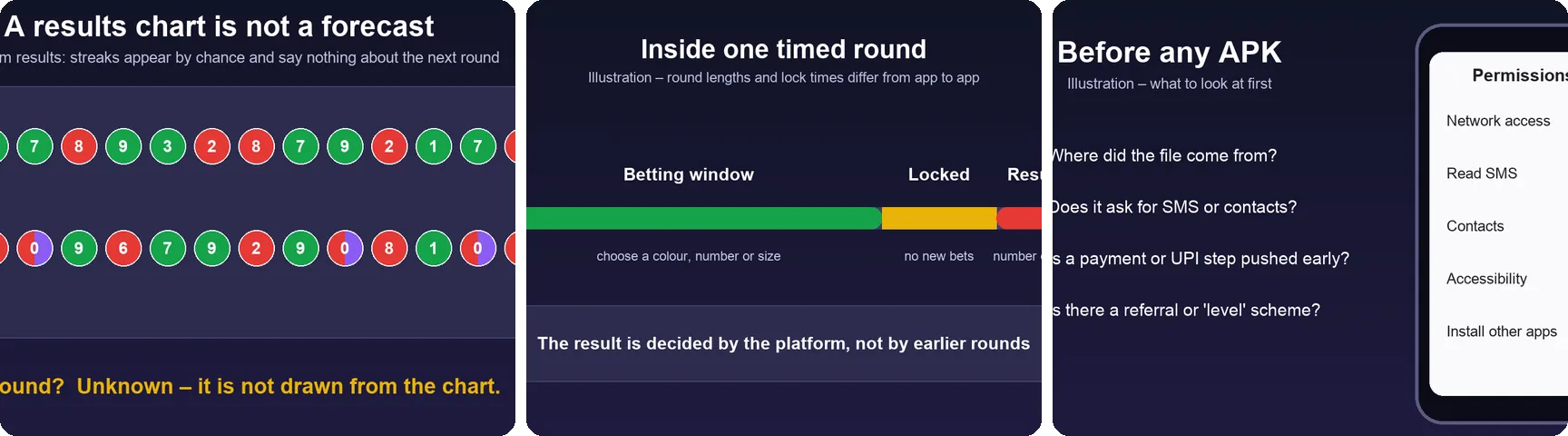
In a typical round you back a colour (green, red or violet), a number from 0 to 9, or Big against Small, and a timer of roughly 30 to 60 seconds runs out. Then the app shows one digit. An education blog from Rupeezy, a SEBI-registered broker, states the point that matters most for any forecast: the platform's algorithm sets the result. The player is not watching a physical draw or a market price. The outcome comes from software owned by the same company that pays or keeps the stakes.
That ownership changes the whole question. A forecast can only work if the thing being forecast follows a pattern that outsiders can see. Here the only party who knows how results are produced is the operator, and the operator's income depends on players losing more than they win. No outside method can read code it never sees.
What a color trading chart records
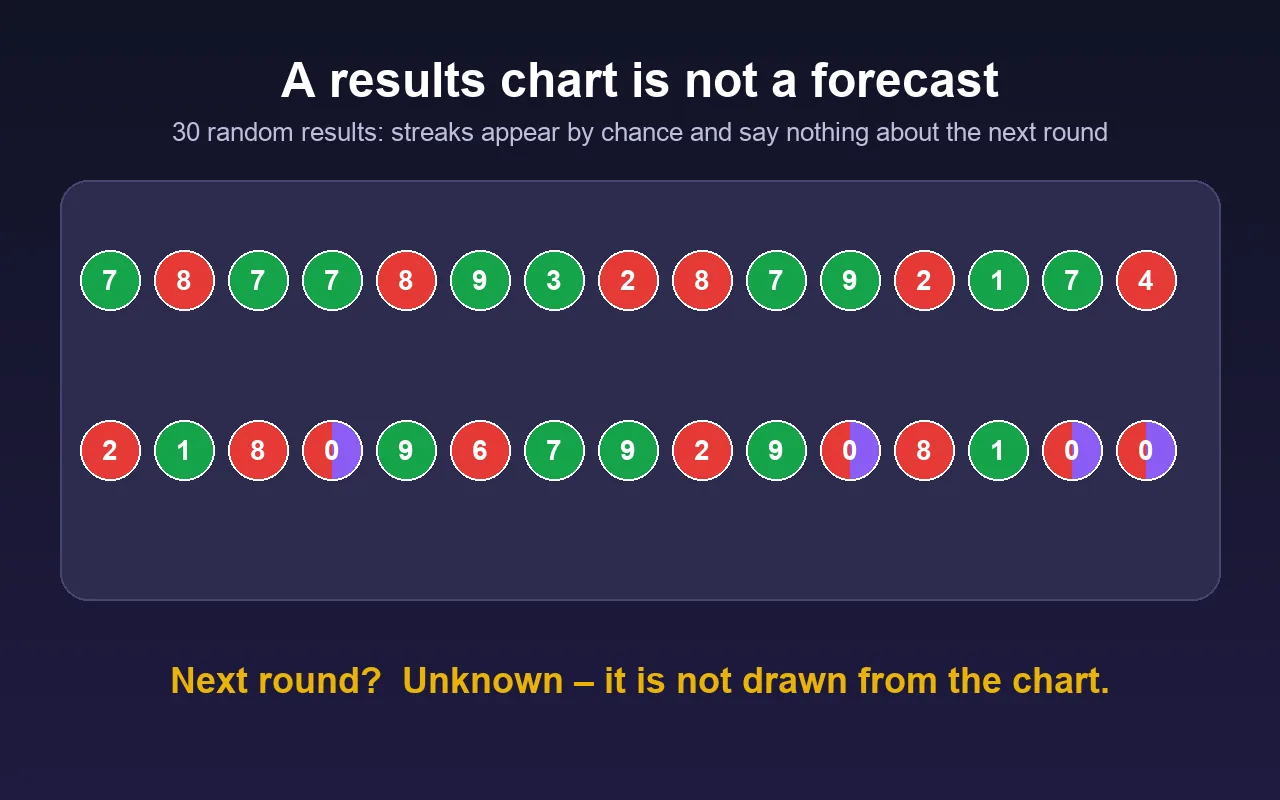
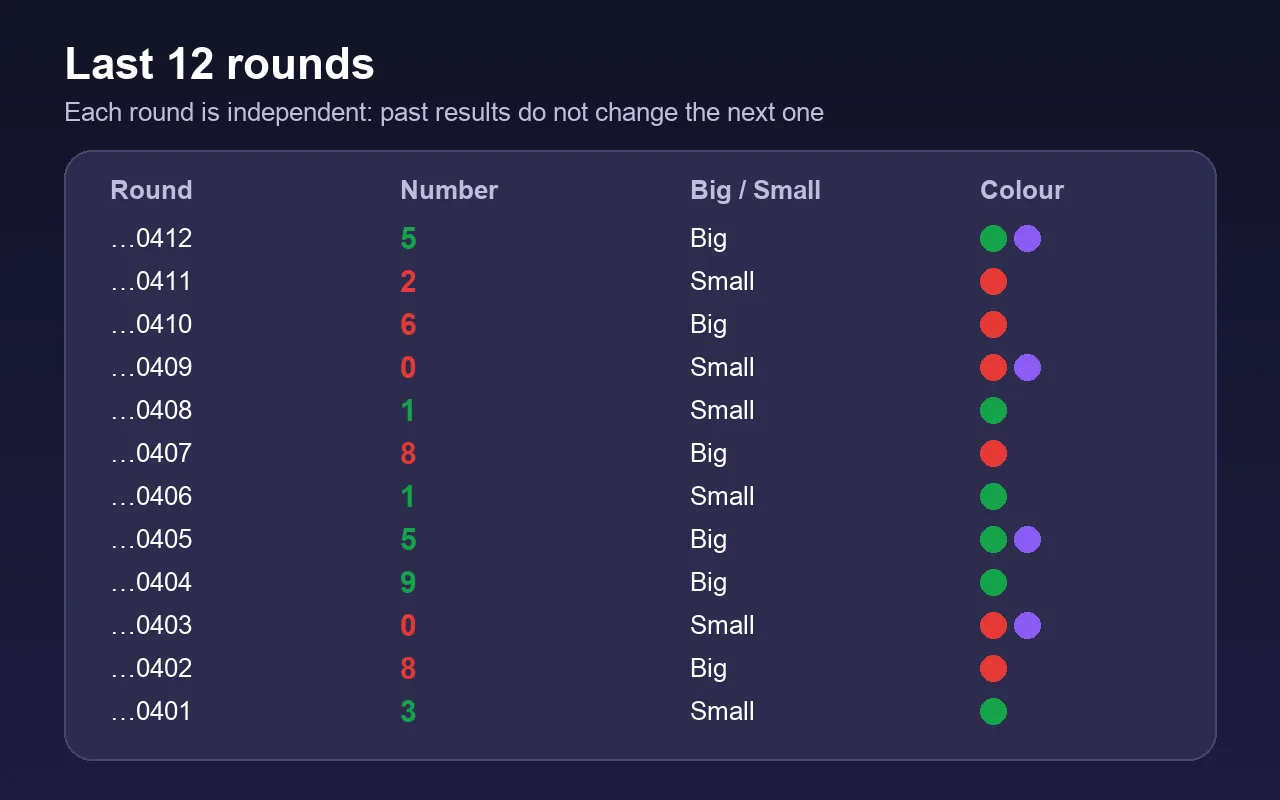
Most apps show a table of recent rounds: the period number, the digit, whether it was Big or Small, and a coloured dot. Prediction groups screenshot this history, draw lines on it and call it a color trading chart, much as a stock chart might be annotated. The resemblance is cosmetic. A share price reflects buyers and sellers; this table reflects only what the software chose to display.
Pattern-hunters usually look for three things: streaks, alternations and "due" colours. A run of six reds feels as if it must end. Yet if the results are independent, the seventh round carries the same odds as the first, and if they are not independent, the only party who knows the rule is the operator. Either way the table gives a player nothing to act on. Humans see shapes in random noise very easily, and a column of coloured dots is ideal material for that habit.
The level maintain table, run to its end
The table sold in groups is usually a doubling plan. You bet one unit on a colour; after a loss you bet two, then four, then eight, and so on until a win recovers everything plus one unit. On paper it never loses. Here is what a losing run does to it:
- after three losses in a row, the fourth stake is 8 units and 7 are already gone;
- after five losses, the sixth stake is 32 units with 31 lost;
- after eight losses, the ninth stake is 256 units with 255 lost, all to win back a single unit;
- promotional pages for such apps quote 2x on red or green, so even the winning round only returns the stake plus one unit of profit;
- a timer of about a minute means a run of eight losses can arrive within ten minutes.
The plan does not change the odds of any round. It reshapes losses into many small gains and an occasional catastrophic one, and wallets or limits usually run out before the streak does. There is also no guarantee that a red or green result is as likely as the layout suggests, because, again, the operator's algorithm decides.
Signal channels and the color trading hack
Paid prediction channels, "VIP" signal groups and anything advertised as a color trading hack share one weakness: none of them has access to the operator's system. A hack that could change results would need control of someone else's server; a predictor app installed on your phone has no such control. A Google Play search for "colour prediction" on 29 October 2026 returned only predictor, calculator and analyser utilities, and no real-money betting platform. Those tools can read a history table, which, as shown above, carries nothing useful.
Why does color trading prediction still sell, then? News reports from 2021 describe apps that reward users for recruiting new players. A channel that sends members to an app with a referral code earns from sign-ups and deposits whether its signals work or not. The same reports describe players in Bengaluru and Chennai who saw winnings in their wallets but were told to deposit more before they could withdraw. Signals do nothing about that problem.
If you want to understand the color trading game itself without any of these add-ons, the round reduces to one digit chosen by software you cannot inspect. Everything sold on top of it is a story about that digit.
The law, the payments and your stop point
The Promotion and Regulation of Online Gaming Act, 2025 covers any online game where a user stakes money or money-convertible credits in the hope of a financial return, whether the outcome turns on skill, chance or both. It forbids offering such games, advertising them and facilitating their payments. Its Rules have been in force since 1 May 2026, and banks and payment systems may not process money for these games. A paid colour-prediction round fits the definition on a plain reading, although no government notice we found names the genre. Selling signals that promote such betting sits uncomfortably close to advertising it. This is general information, not legal advice.
Our rating below scores the prediction claims, not the round. If you are 18 or older and still decide to bet, set a loss limit and a time limit in advance, and treat reaching either as the end of the session. A doubling table is a plan to break that limit. For support with gambling that feels out of control, call Tele-MANAS on 14416 or 1-800-891-4416.
What we collect while you read
Signals or tips: This page sells no signals, predictions or group memberships, and asks for nothing in exchange for reading.
Identity: No name, mobile number or login is requested. You stay anonymous to us as a reader.
Money: No payment form, UPI request or wallet appears here. We take no fees for any part of this guide.
Apps: We ask you to install no predictor or hack tool. Such tools cannot see an operator's system.
External button: The button at the top opens an external page. Check its owner and its requests before sharing anything.


Scoring the prediction claims
What works
- The myths are easy to test: a few lines of arithmetic expose a doubling table
- History tables are visible in most apps, so anyone can see they carry no signal
- Claims of a hack can be dismissed simply by asking how it reaches the server
What to keep in mind
- Results are set by operator software that no predictor can read or change
- Doubling tables risk hundreds of units to recover a single unit
- Signal channels may earn from referrals whether their calls work or not
Questions about colour forecasts and tables
Can a results history show which colour is due?
No. A history table lists what the software displayed in earlier rounds. If each round is independent, nothing is ever due, and a seventh red is as likely as the first. If rounds are not independent, only the operator knows the rule. In both cases the table gives a player nothing to bet on. Streaks feel meaningful because people spot patterns in noise very easily.
Does a level maintain table stop losses in colour betting?
It hides them for a while. Doubling the stake after each loss means eight losses in a row require a ninth stake of 256 units, with 255 already lost, to win back one unit. With rounds lasting around a minute, such a run can arrive quickly. The table does not change any round's odds; it simply concentrates losses into rare, very large ones.
Are paid colour signal groups worth the fee?
There is no evidence that any group can see the operator's system, which is where results are set. News reports describe apps that reward users for recruiting players, so a group can earn from referrals regardless of how its calls perform. Paying for signals adds a second cost to a bet that already favours the house, and it brings you no closer to a reliable forecast.
Could a colour hack app on my phone change the result?
A tool on your phone has no access to the operator's server, which is where the digit is chosen. A Play search on 29 October 2026 showed only predictor, calculator and analyser utilities, none of which can alter a result. Apps offered as hacks through chats or websites cannot be verified either, and installing an unknown file puts your phone and its data at risk.
What does India's 2025 gaming law say about colour signal sellers?
The Promotion and Regulation of Online Gaming Act, 2025, with Rules in force since 1 May 2026, bans offering online money games, advertising them and facilitating their payments. A paid colour round fits its definition on a plain reading. The Act does not mention signal sellers by name, and we cannot give legal advice, but promoting such betting comes close to the advertising the Act prohibits.
Why do prediction screenshots show so many wins?
Screenshots are chosen after the fact. A group posting calls can share the rounds that worked and stay quiet about the rest, and a wallet balance on screen says nothing about whether it was ever withdrawn. Reports from 2021 describe players who saw winnings but were asked to deposit more before cashing out. Judge a claim by withdrawals to a bank account, never by images.